UK hoteliers aren't struggling because guests stopped booking — occupancy has mostly recovered. They're struggling because costs are rising faster than revenue, while most hotels are still pricing on gut feel. This guide shows exactly where that gap is costing you, and what to do about it.
Hotels are busy again. In most of the UK, guests came back after the pandemic and bookings have settled back to normal. So if things are busy, why does it still feel harder to make money than it used to? Because the problem was never how many rooms you sell. It's what's left over once the bills are paid — and those bills have grown much faster than room revenue has.
The numbers back this up. In Q1 2026, UK hotels grew total revenue by just 2% — but costs across labour, energy, food, rates, and VAT grew much faster than that. The result: the average UK hotel's profit margin shrank to 22.3%, down from 23.4% the year before. Even London, usually the strongest market, saw occupancy dip and room rates flatten at £128.54 a night. None of this is a crash. It's a slow squeeze — and five specific pressures are driving it:
| Pressure | What it means |
|---|---|
| VAT | UK hospitality VAT is 20% — France and Spain charge 10%, Germany 7%. A summer 2026 cut to 5% covers only children's meals and family attractions, nothing for rooms or general F&B — that rate returns in full from 2 September. A £1.4m/year property may pay £230,000+ in VAT, on a margin that leaves almost nothing after labour, food, and debt. A 20%→10% cut is now back in live political conversation under the new PM, though not yet committed. |
| Labour costs | National Living Wage up again, employer NI up to 15% (April 2025, though the new PM has pledged to review this), and the Employment Rights Act 2025 makes staffing more rigid — zero-hours contracts constrained, unfair dismissal protection from 6 months' service (Jan 2027). |
| F&B cost inflation | Beef, seafood, dairy, and wine all up sharply — supply chain pressure, post-Brexit friction, and energy costs flowing through food production. Alcohol duty rose 3.66% in February 2026. |
| Business rates relief withdrawn | The 40% hospitality discount ended 31 March 2026, replaced by a more complex system. Average hotel rates are up 115% over three years. A new 20% cut for pubs, clubs, and live music venues starts April 2027 — hotels aren't included. |
| Debt & interest | Many hotels refinanced post-pandemic debt taken out near-zero, now serviced at much higher rates — quietly eating margin even where top-line revenue looks stable. |
Put simply: none of these five things are your fault, and none of them are things you can negotiate your way out of. VAT is set by the government. Wages are set by law. Your rates bill is set by the council. Food and drink prices are set by suppliers you don't control. And debt repayments are set by whoever you refinanced with. Every one of these costs was already there — they've just all gone up at the same time, and none of them are coming back down soon. That's why a hotel can be just as busy as last year and still make less money: it's not earning less, it's keeping less.
This is exactly why pricing matters more this year than it did two or three years ago. When margins were wider, a badly priced week was an inefficiency. Now that five separate cost pressures have landed on the same margin at the same time, that same badly priced week is the difference between a hotel that's comfortable and one that's barely getting by. The stakes on every pricing decision went up — even though the decision itself hasn't changed.
So if you can't control the costs, what can you control? One thing, and it's the one thing this whole guide is about: the price on the board, room by room, night by night. That's the only lever left that's fully in your hands — and next up is exactly where most hotels are leaving money on that table without realising it.
Your margin problem isn't a demand problem. Occupancy recovered; costs simply grew faster than revenue did.
The costs above explain why margins are squeezed right now. That's the backdrop — but it's not the whole story. Even without a single one of those five pressures, most hotels would still be losing money in smaller, quieter ways, every single week. These six habits rarely make industry reports, because none of them look like a crisis on their own. They just look like a normal Tuesday.
| Habit | What it costs you |
|---|---|
| Pricing on instinct, not data | Most hotels still set rates on gut feel, last year's pattern, or a quick competitor check — no link to real demand. One badly priced peak weekend in a 30-room hotel can cost an estimated £4,000–£8,000. |
| Overdependence on OTAs | OTA commissions run 15–25%. Every point shifted to direct is immediate margin — if you know which nights to protect for direct and which to release. |
| Last-minute panic discounting | Rates dropped 10–14 days out when occupancy looks soft, even though the booking window usually hasn't closed — demand is often still coming. |
| Missing local events | A concert or trade fair nearby creates a demand spike that's missed entirely, or spotted too late to price for. |
| No visibility on profit per room type | Total revenue and cost are tracked; profit per room type usually isn't — so pricing strategy stays blunt. You can't optimise what you can't see. |
| Forecast and staffing misalignment | Unreliable occupancy forecasts cause over/under-staffing — an estimated 2–4% of total payroll in unnecessary spend a year. |
Look at the table again, and you'll notice all six habits share the same root cause: nobody has time to watch everything at once. A busy owner or manager can't realistically track every competitor's rate, every local event, every booking-pace signal, and every room type's true cost — all while running the actual hotel. So the natural shortcut is to price on gut feel, react when occupancy looks soft, and stop looking closely once a room is filled, whatever the price. None of that is a mistake exactly — it's just what happens when there's too much to watch and not enough time to watch it. The problem is that each of those small shortcuts costs real money, every week, and they add up quietly enough that most hotels never actually see the total. That "10–15% left on the table a year" figure isn't one bad decision — it's dozens of small ones, compounding.
That's the part that's fully within your control — which raises an obvious question: are any hotels actually getting this right?
None of these six habits look urgent on their own — that's exactly why they're easy to ignore, and expensive to leave unfixed.
Not every hotel is struggling equally. Some are actively growing through this squeeze, and it's not luck — they're making specific, deliberate changes to how they run the business. Here's what that actually looks like in practice:
The common thread across all six: every one of them needs better information to work well. You can't price F&B dynamically without knowing demand patterns. You can't protect direct bookings without knowing your channel mix. You can't repurpose space without knowing when it's actually idle. That's not a coincidence — it's exactly the gap that revenue management software is built to close, which is what comes next in detail.
Hotels growing through this squeeze all share one thing: better information, not better luck.
You can't fix VAT, wages, or your rates bill — those are fixed costs, set by someone else. What you can fix is every one of the six everyday habits covered in the section above. That's the job of a revenue management system: software that prices your rooms automatically, based on real demand data, instead of leaving it to gut feel. Here's exactly how it addresses each of those six habits, one at a time:
A revenue management system doesn't take away your control of pricing — it takes away the guesswork behind each decision.
Everything above solves a specific habit. Put together, here's what that adds up to in practice:
None of this requires a bigger team or a bigger budget. It requires a system built to do this, instead of a person trying to do it manually, on top of everything else they're already running.
Picture every room priced correctly for tonight, automatically — and, on top of that, a clear read on how the weeks and months ahead are shaping up, without anyone checking anything by hand. That's what running on happyhotel actually looks like.
In plain terms: happyhotel is a revenue management system built around two things working together — dynamic pricing, which sets the right rate for every room, every night, based on real demand data, and demand forecasting, which takes that same data and projects it forward, so you also know how a room, a room type, or your whole hotel is likely to sell over the weeks and months ahead. The pricing is the day-to-day engine. The forecast is what that same engine tells you about the future. Here's what actually happens behind it:
Most hotels run happyhotel on autopilot — prices adjust automatically overnight, and there's nothing to manually check each morning. If you'd rather stay closer to the wheel, you can review suggested changes before they go live instead. Either way, you get a simple dashboard showing what's happening across your rooms, a clear view of what competitors are charging, and reporting that shows — in plain numbers — what's working and what isn't.
The same data that sets tonight's price also feeds forward into the forecast — a read on demand weeks or months out, useful well beyond pricing alone, for planning staffing and cash flow too. Onboarding is guided directly by the happyhotel team, so there's no lengthy technical setup on your end.
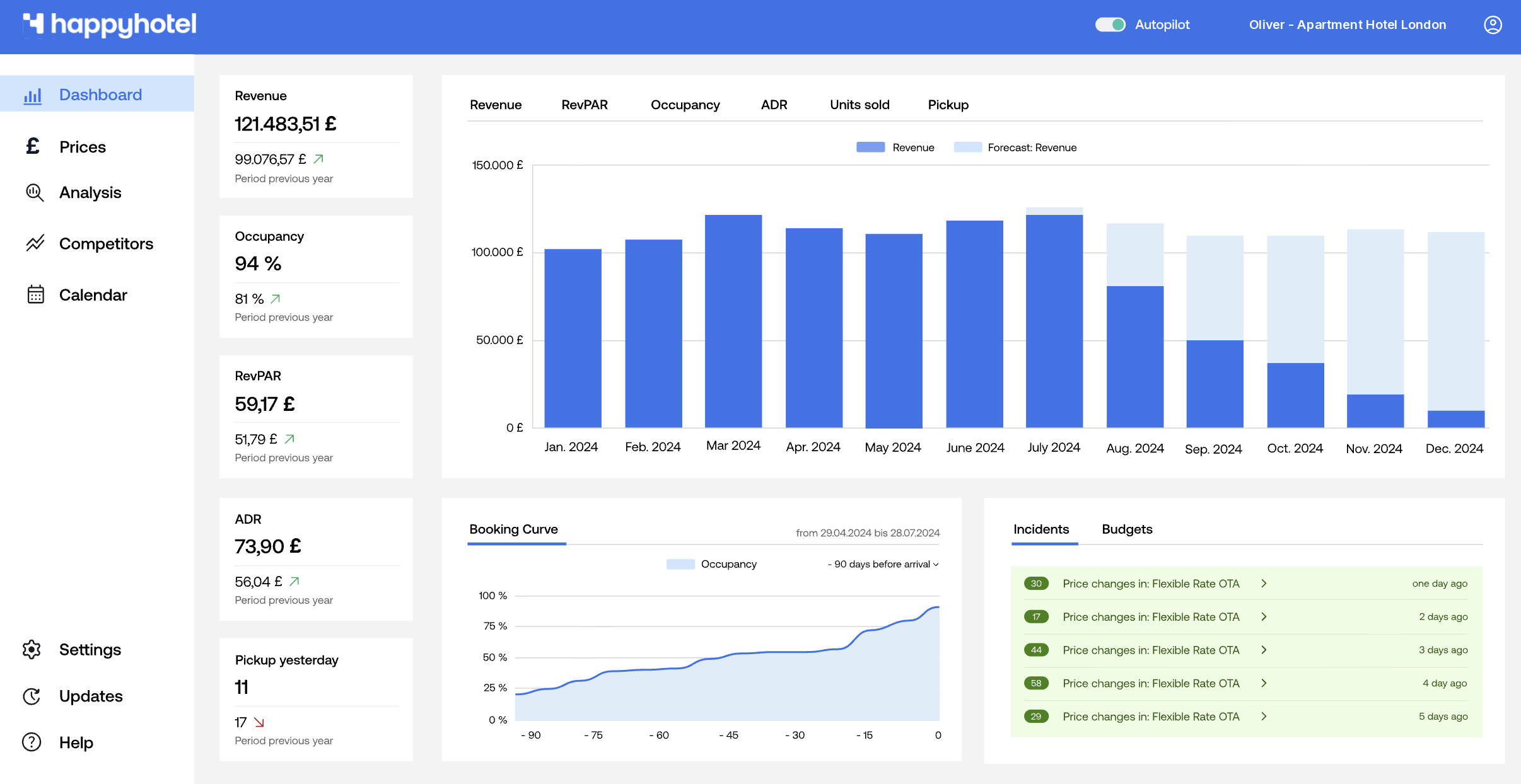
This kind of forecasting and pricing intelligence has existed for years — usually inside expensive enterprise software, run by a dedicated revenue management team. Most hotels don't have the budget or the headcount for that, and it isn't only smaller, independent properties who feel that gap — plenty of small hotel groups are in exactly the same position. happyhotel is built to close it: the same kind of forecasting and pricing intelligence larger operators rely on, without the enterprise price tag or the need to hire someone new to run it. It's meant to be run by a busy owner, GM, or small ops team alongside everything else they're already doing, not to become a second job.
Behind the scenes, each price is set using six things: your own hotel's past booking data, your current booking curve, occupancy levels, competitor prices, nearby events, and overall market demand. Exactly how much weight each factor gets depends on your specific hotel type and location.
happyhotel forecasts what's coming and prices for it automatically — giving hotels in the UK the kind of revenue management intelligence that used to require a bigger team and a bigger budget.
Reading about other hotels is useful, but the only numbers that really matter are your own. Still, it helps to know the pattern is real: happyhotel already runs in more than 1,000 hotels and accommodations worldwide, including a growing number of UK hotels. The Viking Hotel case study below is one full example — but the pattern shows up across the board:
Runs almost entirely on the dynamic prices happyhotel generates, rather than second-guessing them.
Average daily rate increased within a year of switching to happyhotel.
Turnover up year on year after adopting automated pricing.
Sales rose at one property compared to the year before.
Their pricing tool felt more complicated than it needed to be — the team wanted something simpler.
Switched to happyhotel and moved pricing onto full "autopilot," guided through onboarding by the team.
A clear, positive shift in revenue, plus real time saved from no longer adjusting prices by hand.
"We wanted a system simpler than what else was on the market — one that runs smoothly, so we can focus on strategy instead of manually checking prices every day."— Lyndsey Leeming, Revenue Manager
Read the full case study →Viking isn't an outlier. Two more hotels running happyhotel today:
"happyhotel has given us completely new opportunities to check and adjust our prices. We were able to significantly increase our turnover — I'd say an increase in sales of between 30–40%."
"Since introducing happyhotel, sales have risen by 15%. What's even more important: every additional euro we generate through it means a 90% profit for us."
The results above aren't outliers — they're what tends to happen once a hotel's pricing runs on its own data instead of a guess.
A 10-minute audit of your current pricing approach.
Before considering any new tool, it's worth knowing exactly where your current approach stands. Answer honestly:
There's no pass or fail score here — but as a rule of thumb, if you answered "no" or "not sure" to three or more of these, it's a reasonably strong sign that pricing is currently costing you more than it needs to. That's not a reflection on how well you run the hotel day to day — it usually just means nobody has had the time to build a proper system around pricing specifically, which is exactly the gap a good revenue management system closes.
If you do start looking at pricing tools, it's easy to get lost comparing feature lists. In practice, only four things actually matter — and each one maps directly back to one of the everyday habits already covered:
In 20 minutes, we'll look at your last 12 months of booking data, show you where your pricing is already working, and what it's costing you where it isn't — whether or not you ever become a customer.