
.png)


The cost of a revenue management system includes more than the monthly subscription, so it helps to look at the complete investment.
A 50-room hotel may see one RMS at €300 per month and another at €400 and assume the first option is cheaper. But the monthly licence fee alone tells you very little about the actual economics of the system.
To compare RMS costs properly, you need to look at what is included, what costs extra and how much value the system would need to create to justify the investment.
That can include:
- Software subscription fees
- PMS or interface costs
- Setup and onboarding
- Required add-ons
- Internal implementation time
- Ongoing pricing workload
- Potential revenue improvement
- Time saved through automation
For hotels, an RMS can create value in several ways: helping capture stronger demand, reducing unnecessary discounting, identifying important dates earlier, improving pricing consistency and reducing manual work.
So the financial question is not simply:
“How much does the RMS cost?”
It is:
“What is the total cost of using it, and what improvement would our hotel need for that investment to make financial sense?”
If you are still comparing what an RMS should actually do, start with How to Choose Revenue Management Software for Hotels. This guide focuses specifically on the financial decision.
How Much Does Revenue Management Software Cost?
There is no universal pricing model for hotel revenue management software.
Depending on the provider, an RMS may be priced:
- Per room
- Per property
- By hotel or room-count band
- By product package
- By module
- Through a custom quote for larger or more complex operations
What is included in that price can also vary significantly.
One provider may include forecasting, automated pricing and competitor-rate data within its package, while another may structure some functionality across different tiers or additional modules.
Integration, onboarding, multi-property functionality and support arrangements can also differ.
That is why a useful RMS cost comparison needs to look beyond the headline monthly fee.
When comparing systems, check the configuration your hotel would actually need to use:
| Pricing element | What to check |
|---|---|
| Base subscription | Per room, property, room-count band, package or custom quote? |
| Minimum billing | Is there a minimum room count, property charge or annual minimum? |
| PMS integration | Included in the RMS price or charged separately? |
| Setup & onboarding | Included, one-off fee or optional paid service? |
| Rate shopping | Included or a separate module/add-on? |
| Multi-property | Included, priced per property or a separate package? |
| Training & support | What level is included, and is additional support charged? |
| Contract & billing | Monthly, annual or multi-year commitment? |
| Other modules | Are forecasting, reporting or other required features included in the selected package? |
The aim is not to assume that every provider charges separately for these elements. It is to understand what is included in the price you are comparing. The most useful number is therefore not necessarily the monthly subscription shown on a pricing page. It is the total annual cost of using the RMS in the way your hotel actually needs it.
What Is the True Cost of a Revenue Management System?
The full investment can extend beyond the software subscription.
A useful way to structure RMS costs is around four areas:
- Software subscription
- Integration and setup
- Required modules and add-ons
- Internal time
1. Software Subscription
The subscription is the most visible cost, but vendors structure it differently.
An RMS might be priced by:
- Room
- Property
- Property size
- Product tier
- Module
- Custom agreement
Compare annualised costs using equivalent functionality.
RMS packages can include different levels of functionality, so the most useful comparison is between configurations that cover what your hotel actually needs. The important question is therefore not simply which provider has the lowest advertised price, but what functionality you receive for that price.
2. Integration and Setup Costs
An RMS depends on reliable hotel data, usually through the property management system.
Before comparing prices, clarify whether the quoted cost includes:
- PMS connection
- Interface fees
- Initial setup
- Historical data configuration
- Room and rate mapping
- Testing
- Training
- Onboarding support
That is why it helps to understand what sits behind the per-room price and what is included in the complete setup.
3. Optional Modules
Some functionality may sit outside the selected package.
Depending on the provider, that could include:
- Competitor-rate shopping
- Multi-property functionality
- Advanced reporting
- Portfolio functionality
- Additional integrations
- Other specialist modules
Ask vendors to quote the setup you realistically expect to use rather than only the lowest possible configuration.
4. Internal Time
Internal time is easy to overlook.
Even an RMS designed to automate work requires effort during:
- Vendor evaluation
- Implementation
- Training
- Initial pricing setup
- Early monitoring and adjustment
The useful comparison is against the hotel's current pricing workload.
If the team currently spends hours reviewing future dates, checking competitor rates, monitoring pickup and manually adjusting prices, some of that work may be reduced after implementation.
The value of that time can form part of the business case.
-p-1080.png)
Compare RMS Providers Using Total Cost of Ownership
A simple total-cost model is:
Annual software subscription + integration or interface costs + onboarding and setup costs + required add-ons + other recurring fees = Total annual RMS cost
For multi-year agreements, separate:
Year 1 cost
from:
Ongoing annual cost
because implementation and connection fees can make the first year more expensive.
RMS Cost Comparison Template
Use the same structure for every provider.
| Cost category | Provider A | Provider B | Provider C |
|---|---|---|---|
| Annual subscription | |||
| PMS/interface fees | |||
| Setup/onboarding | |||
| Rate shopping | |||
| Forecasting/automation | |||
| Multi-property | |||
| Required additional modules | |||
| Training/support | |||
| Total Year 1 cost | |||
| Ongoing annual cost |
This makes it much easier to compare like with like instead of comparing subscription prices that include different functionality.
When Does an RMS Pay for Itself?
An RMS pays for itself when the measurable value it creates exceeds the cost of using it.
That value can come from more than one source.
A useful RMS business case looks at three areas together:
- Revenue opportunity
- Time and process value
- Decision quality and consistency
-p-1080.png)
1. Revenue Opportunity
Look for places where pricing opportunities may currently be missed.
For example:
- Does the hotel regularly sell out unusually early?
- Do rates stay unchanged when booking pace accelerates?
- Are important events sometimes discovered after bookings have already increased?
- Do some room categories sell much faster than others without corresponding price changes?
- Are discounts opened quickly when short-term pickup looks weak?
- Are future dates reviewed infrequently because the team does not have enough time?
These signals cannot tell you exactly how much revenue an RMS will generate.
They can tell you where revenue management opportunities may exist.
There is no universal percentage uplift that applies to every hotel. Performance depends on the hotel's market, demand pattern, current pricing process, starting point and implementation.
2. Time and Process Value
Then measure the current pricing workload.
Ask:
- How many hours per week are spent on pricing?
- Who does that work?
- How much manual competitor checking is involved?
- How many future dates need to be reviewed?
- How many room categories require individual attention?
- How dependent is the pricing process on one person’s availability?
Automation can help keep the pricing process consistent even when the person responsible has other priorities or is unavailable.
For some hotels, this time and process value forms a significant part of the return.
How happyhotel Reduces Manual Pricing Work
happyhotel continuously monitors future dates and generates price recommendations based on the hotel's booking situation, forecast and relevant demand signals. With Autopilot, price changes can also be applied automatically within the pricing strategy and boundaries defined by the hotel.
For a hotel where somebody currently spends time checking pickup, competitor rates and future prices manually, this is where part of the operational value of an RMS can come from.
3. Decision Quality and Consistency
Some value is harder to put into a single euro figure.
Consider:
- Are important dates reviewed consistently?
- Can the team explain why rates changed?
- Are prices based on current booking data?
- Are all relevant room categories reviewed?
- Does the hotel respond consistently when demand changes?
- Is pricing dependent mainly on one person's availability or intuition?
Decision quality may not appear as a separate line in an ROI calculation, but it can influence revenue, workload and operational consistency.
What Better Decision Visibility Looks Like
An RMS should not only change prices. The hotel should also be able to understand why a recommendation changed.
With happyhotel's Pricing Transparency, hotels can see the factors behind a recommendation, including the demand indicator, events and competitor prices, as well as whether booking development or the hotel's own pricing settings affected the final result.
How to Calculate RMS ROI, Payback and Break-Even
Once you know the complete cost of the RMS and the areas where value may be created, you can calculate the economics more directly.
There are three useful calculations:
- ROI
- Payback period
- Break-even improvement
Revenue Uplift Is Not the Same as Profit
When calculating ROI, it helps to distinguish between additional room revenue and the contribution or profit the hotel ultimately keeps. If an RMS contributes to €10,000 in additional annual room revenue, that does not automatically mean the hotel gained €10,000 in profit.
Additional revenue can still involve:
- Distribution commissions
- Transaction costs
- Variable room costs
- Other incremental operating expenses
Where the data is available, a more rigorous ROI calculation should therefore use incremental contribution or profit rather than gross revenue alone.
How to Calculate RMS ROI
A standard ROI formula is:
ROI = (Financial benefit − RMS cost) ÷ RMS cost × 100
For an RMS, measurable financial benefit might include:
- Incremental contribution from improved room revenue
- Financial value of labour saved
- Other measurable operating savings
Illustrative ROI Example
Assume the complete annual cost of an RMS is:
€4,000
During the measurement period, the hotel attributes:
€8,000 in incremental contribution
and:
€2,000 in measurable labour savings
to the new revenue-management process.
Total measurable benefit:
€8,000 + €2,000 = €10,000
Net benefit:
€10,000 − €4,000 = €6,000
ROI:
€6,000 ÷ €4,000 × 100 = 150%
This is an illustrative example, not a benchmark for what a hotel should expect.
The useful part is the method:
Use your hotel's actual cost and measurable benefit rather than assuming a generic industry uplift.
How to Calculate RMS Payback Period
ROI measures return relative to the investment.
Payback period answers a different question:
How long does it take before the measurable value created has covered the investment?
A simplified formula is:
Payback period = RMS investment ÷ average monthly financial benefit
If the annual RMS investment is €4,000 and measurable incremental contribution or savings average €1,000 per month:
€4,000 ÷ €1,000 = 4 months
The simplified payback period is therefore:
4 months
Again, this is an illustrative calculation rather than an expected result.
-p-1080.png)
Calculate the Break-Even Improvement
Instead of starting with what an RMS might achieve, start with what it costs. Work backwards from your actual cost and ask:
What improvement would our hotel need for this investment to cover its cost?
Suppose the complete annual cost of an RMS for a 50-room hotel is:
€4,000 per year
and annual room revenue is:
€1,000,000
Then:
€4,000 ÷ €1,000,000 × 100 = 0.4%
So €4,000 represents 0.4% of annual gross room revenue.
This is an illustrative example, not a benchmark. It also does not mean a 0.4% increase in gross revenue automatically produces €4,000 in incremental profit.
But it gives the hotel a concrete threshold to investigate:
Can the combination of incremental contribution, time saved and other operational value realistically cover the investment?
That is a more useful business-case question than starting from an assumed outcome.
-p-1080.png)
What Should You Measure Before Introducing an RMS?
If you want to evaluate ROI later, establish a baseline before implementation.
Otherwise, it becomes difficult to tell what changed.
A useful baseline can be divided into three areas.
Financial Baseline
Track:
- Room revenue
- ADR
- RevPAR
- Occupancy
- Contribution or contribution margin where available
Revenue Management Baseline
Track:
- Pickup
- Booking pace
- Dates that sell out unusually early
- Important demand dates discovered late
- Room-category performance
- Discount usage
- Frequency of price changes
Operational Baseline
Track:
- Hours spent on pricing each week
- Manual competitor checks
- Number of future dates reviewed
- Number of manual price updates
- People involved in the pricing process
The purpose is not to claim that every future improvement came exclusively from the RMS.
Hotel performance is affected by:
- Market demand
- Events
- Seasonality
- Distribution
- Marketing
- Competitor behaviour
- Changes to the hotel itself
A baseline gives you a more credible before-and-after reference.
How Long Should You Give an RMS Before Judging ROI?
There is no universal period after which every RMS should have paid for itself.
The right measurement window depends on:
- Hotel seasonality
- Booking lead time
- Implementation timing
- Available historical data
- Demand volatility
- The point in the commercial calendar when the RMS goes live
For example, a highly seasonal property may need a longer or more representative measurement period to understand the financial impact properly.
Agree what you will measure and when you will review it before implementation.
Some indicators can be monitored quickly:
- Time saved
- Number of pricing updates
- Pricing workflow consistency
- Reduction in manual checking
Financial impact often needs a longer and more representative measurement period.
What RMS Value Can Look Like in Practice
The value of an RMS does not always show up in the same way. For one hotel, the biggest impact may be higher revenue or ADR. For another, it may be the time saved through automated pricing.
The examples below show different ways happyhotel customers have described the value they saw after introducing the system. These are individual customer results and should not be treated as a benchmark for what every hotel will achieve.
Sonnenhof Lautenbach: Revenue and Profit
Rodolfo Schierloh from Sonnenhof Lautenbach reports that sales increased by 15% after introducing happyhotel.
“Since the introduction of happyhotel last year, sales have risen by 15%. But what is even more important: every additional euro that we generate through happyhotel means a 90% profit for us.”
This example is useful because it separates revenue growth from what the hotel says it keeps of each additional euro.
Read the Sonnenhof Lautenbach customer story →
Coffee Fellows Hotel: Time Saved
Ramona Wolters from Coffee Fellows Hotel describes a different type of value:
“When it comes to prices, we rely entirely on the algorithm, which automatically adjusts the prices, which saves us a lot of time.”
For hotels where pricing takes up significant management time, this kind of operational saving can be part of the RMS business case alongside financial performance.
In happyhotel, hotels define minimum and maximum prices and pricing strategies, and the automated pricing works within them.
Read the Coffee Fellows Hotel customer story →
Customer results can illustrate the different forms RMS value can take.
They should not be treated as universal performance promises.
| Hotel | Type of value reported |
|---|---|
| Sonnenhof Lautenbach | Revenue and profit |
| Coffee Fellows Hotel | Time saved |
Calculate Your Own Revenue Potential Instead of Using a Generic Benchmark
A hotel's own numbers are more useful than an industry-average promise. Two free happyhotel tools help you estimate whether revenue management software could be worthwhile for your specific property:
- The Potential Analysis uses information about your hotel, market and target audience to estimate the potential revenue improvement, the ROI factor and the expected costs.
- The Profitability Calculator lets you enter your room count, annual revenue and weekly pricing workload, then see how different assumed revenue improvements affect payback time and time saved.
Use the Potential Analysis for a first, property-specific assessment. Use the calculator to test your own assumptions, for example what happens to payback time if the improvement is smaller than you hoped. Testing several realistic scenarios can give you a more useful view of how the business case changes under different assumptions.
Both give estimates, not guarantees. Neither replaces measuring results after implementation.
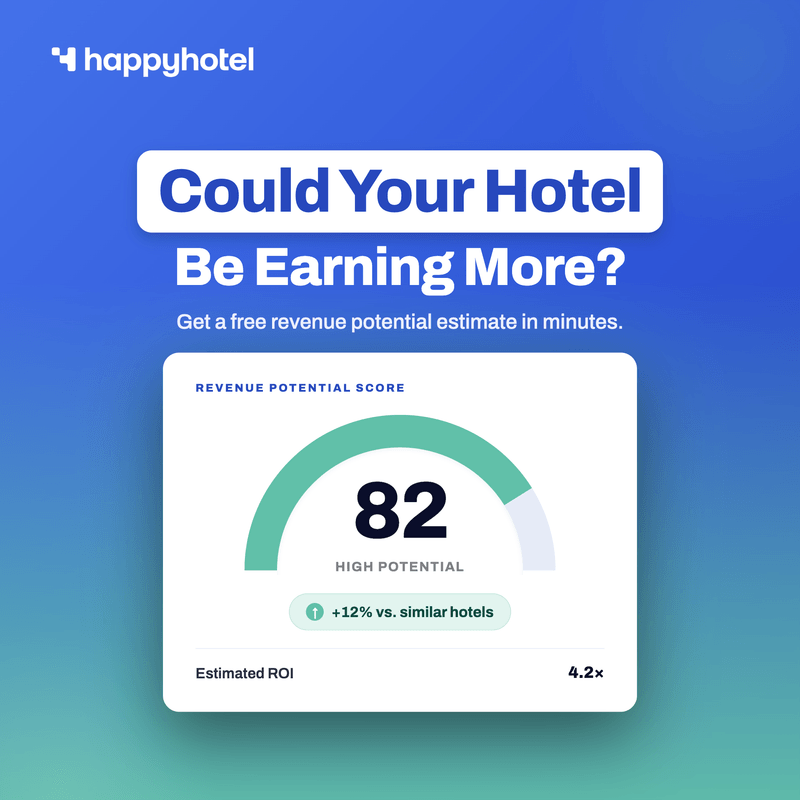
happyhotel's free Potential Analysis uses your hotel's own data to estimate the potential revenue improvement, the ROI factor and the expected costs, so you get a property-specific starting point instead of an industry average.
How to Put RMS ROI Figures Into Context
Customer results and industry benchmarks can provide useful context. To understand how relevant a figure may be for your hotel, look at the type of properties behind it, the measurement period, the starting point and the assumptions used in the calculation.
"Hotels increase revenue by X%." An average across many hotels says little about yours. Ask what the figure is based on (which hotels, which period, which starting point) and how comparable those hotels are to yours in size, location and market.
Additional revenue presented as profit. More revenue is not the same as more profit. Extra bookings can come with commissions, higher operating costs or additional fees, so ask what incremental costs sit behind the revenue figure.
An ROI calculation built on one assumed uplift. If the whole case rests on a single percentage, a small change in that number can change the result completely. Look at how the business case holds up under conservative, expected and stronger scenarios, and plan with the conservative one.
A business case becomes much more credible when you can see exactly which assumptions drive the result.
Questions to Ask Before Approving the RMS Budget
Before signing, you should be able to answer:
- What is the full annual software cost?
- What will Year 1 cost including setup and integration?
- Is there a minimum billing level?
- Are any modules we need charged separately?
- Are PMS or interface fees included?
- How much internal implementation time is required?
- What manual revenue-management work should the system reduce?
- Where do we currently see pricing or revenue opportunities being missed?
- What measurable improvement would cover the investment?
- Which KPIs will we use to evaluate performance?
- How will we distinguish RMS impact from broader market changes?
- How and when will we review the results against our original business case?
If these questions are answered, the decision becomes much more concrete than comparing monthly subscription prices.
So, What Should an RMS Cost?
There is no universal “correct” price for revenue management software. The right cost is one that is proportionate to the value the system can realistically create for the individual hotel.
The subscription price only becomes meaningful when you compare it with the value the system can create. A higher-cost RMS may represent a stronger investment if it delivers greater revenue opportunities, time savings or operational value for the hotel.
That is why the useful comparison is:
Total annual RMS cost
versus:
realistic revenue opportunity + time savings + operational value
The licence price matters.
The economics matter more.
Build the Business Case Before You Buy
A good RMS business case begins with your hotel's own cost, baseline and pricing workload. Calculate the complete cost of the system. Establish your current financial and operational baseline. Identify where pricing opportunities or manual workload exist. Then work backwards:
How much measurable improvement would be needed for the RMS to pay for itself?
Once you have that threshold, you can judge whether the required improvement looks realistic for your hotel based on your own numbers.
If you want a property-specific starting point: Check your hotel's revenue potential with happyhotel.
If you are still deciding which RMS capabilities your hotel actually needs, continue with: How to Choose Revenue Management Software for Hotels.
And if revenue management itself is still new to your team: Revenue Management 101 explains the fundamentals behind demand, forecasting, pricing, inventory and distribution.
Frequently Asked Questions About Hotel RMS Cost and ROI
How much does a hotel revenue management system cost?
There is no universal RMS price. Providers may charge per room, per property, by hotel size, package or module, or provide a custom quote. The complete cost can also depend on PMS connections, onboarding, rate-shopping functionality, multi-property requirements and other features. Compare the total annual cost of the configuration your hotel actually needs rather than only the headline subscription price.
How is hotel RMS pricing usually calculated?
RMS pricing can be based on room count, property count, property size, functionality, product tier, modules or an individually quoted package. Minimum room or property charges may also apply. What is included varies by provider and package.
How do you calculate ROI for an RMS?
A simplified formula is: ROI = (Financial benefit − RMS cost) ÷ RMS cost × 100. Where possible, use measurable incremental contribution, labour savings and other relevant financial benefits rather than assuming that all additional room revenue is profit.
What is the payback period of an RMS?
Payback period measures how long it takes for measurable benefits to cover the investment. A simplified calculation is: Payback period = RMS investment ÷ average monthly financial benefit. There is no universal payback period that applies to every hotel. The result depends on cost, current pricing performance, market conditions and the value the system actually creates.
What costs should hotels include when comparing RMS providers?
Include the annual subscription and any relevant PMS or interface fees, onboarding and setup costs, required modules, rate-shopping functionality, multi-property features, support costs and other recurring fees. Separate Year 1 cost from ongoing annual cost where one-time implementation fees apply.
Can a small hotel justify the cost of an RMS?
Potentially. Room count alone does not determine whether the investment makes sense. A smaller hotel may still have meaningful pricing opportunities or spend significant management time on manual revenue management. The useful calculation is how much measurable value the hotel would need to create to cover the complete RMS investment.


