



When happyhotel recommends a room rate, you can see more than the final number. Our Pricing Transparency feature shows the factors and settings behind each recommendation, so you can understand how the price was reached for a particular day and room category.
The recommendation is based on several inputs, including the happyhotel demand indicator, events, competitor prices and booking speed, while your own pricing settings can also influence the final result. In this article, we explain how our hotel price recommendations are created, which factors influence them and how Pricing Transparency makes the path from the initial recommendation to the final price visible.
What Is Pricing Transparency in happyhotel?
Pricing Transparency is the feature in happyhotel that makes the logic behind our price recommendations visible. Rather than showing only the final recommended rate, it lets you see the information and settings that contributed to it.
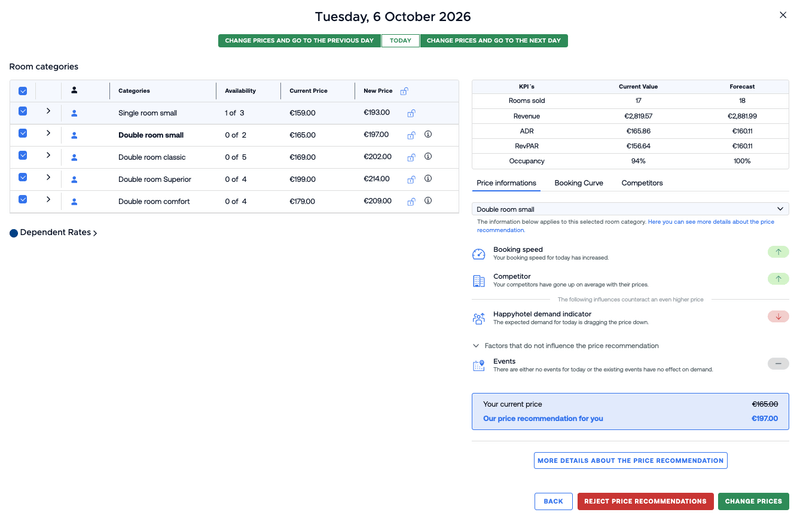
For each day and room category, you can see the initial price recommendation, the happyhotel demand indicator, whether and to what extent events influence the price, competitor prices, how the recommendation changed compared with the previous suggestion, booking speed, whether minimum or maximum prices affected the result, whether a defined pricing strategy intervened, and the final price recommendation.
This gives you a clearer view of how the recommendation was created, instead of leaving you with only the end result. Pricing Transparency is available to all happyhotel customers.
When Is Pricing Transparency Available?
Pricing Transparency is available for hotels whose pricing runs on the RevPAR Combi model. Hotels that are new to happyhotel and don't yet have historical data start on the Base Price model instead, which works with on-the-book data and competitor data only. In that phase, the Pricing Transparency view is not yet displayed in the tool.
It becomes available once historical data, events and other variables are included in the price recommendations.
How Does happyhotel Create Hotel Price Recommendations?
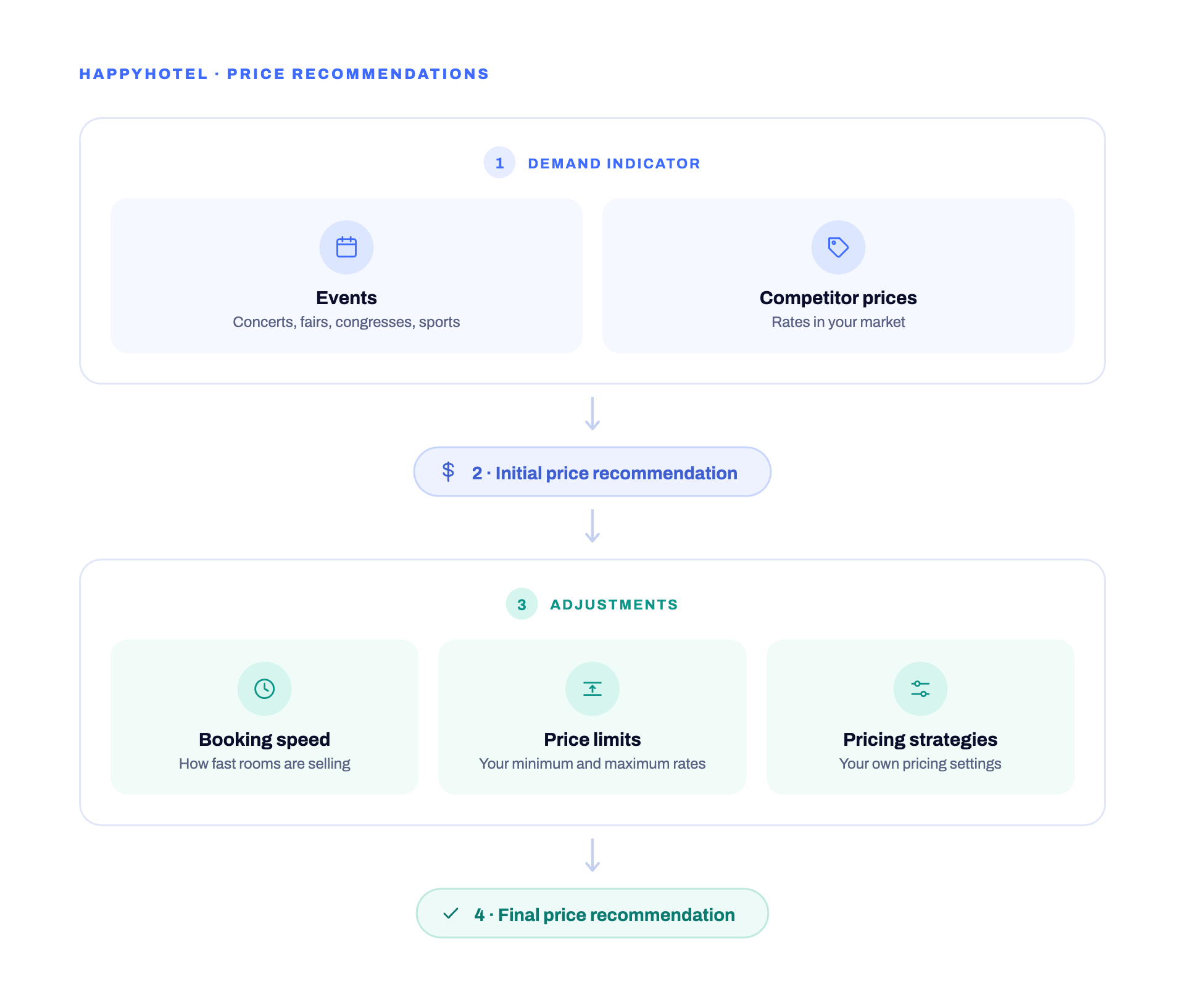
The pricing process starts with a dynamic initial price for each day. Three main factors contribute to that starting recommendation: the happyhotel demand indicator, events in the area and competitor prices.
These factors are dynamically weighted every day, which means their influence can differ depending on the situation. Once the initial recommendation has been created, additional information and settings are taken into account, including booking speed, minimum and maximum prices, and pricing strategies.
A simplified view of the process is:
Demand indicator + events + competitor prices → initial price recommendation → booking speed + pricing settings → final price recommendation
Pricing Transparency makes these stages visible so you can understand how the recommendation develops from the initial calculation to the final result.
The 3 Main Factors Behind the Initial Price Recommendation
1. The happyhotel Demand Indicator
The happyhotel demand indicator shows where the current forecast for your hotel stands. It forms the basis for the RevPAR forecast and continually adapts as new data becomes available.
This means the demand information behind a recommendation can change as the situation develops instead of remaining fixed. For a broader explanation of how hotel data can be used in revenue management, see our hotel data analysis overview.
2. Events in Your Area
Events are another factor included in the pricing calculation, and in happyhotel they can enter the calculation in two ways.
Automatically Imported Events
For automatically imported events, the relevant number of visitors is taken into account directly in the demand indicator. This allows event-related information to contribute to the wider demand picture used in the price recommendation.
Manually Maintained Events
You can also maintain events manually. This can be useful for new or unique events that cannot be represented historically in the same way.
For manually maintained events, you can define the weighting yourself. For each day, you can then see whether an event influences the price and to what extent.
We keep the wider topic of event pricing brief here because this article focuses specifically on how happyhotel creates its recommendations. For a deeper explanation of how events can affect hotel demand and room pricing, see How Events Affect Hotel Demand and Room Pricing.
3. Competitor Prices
Competitor prices are the third key factor behind the initial recommendation. In happyhotel, you can see where your competitors currently stand and how the recommended price has changed compared with the previous suggestion.
This gives you visibility into how developments in competitor pricing are reflected in the recommendation, without turning competitor rates into a separate pricing strategy of their own. For more detail on competitor-rate monitoring, see our Rate Shopper.
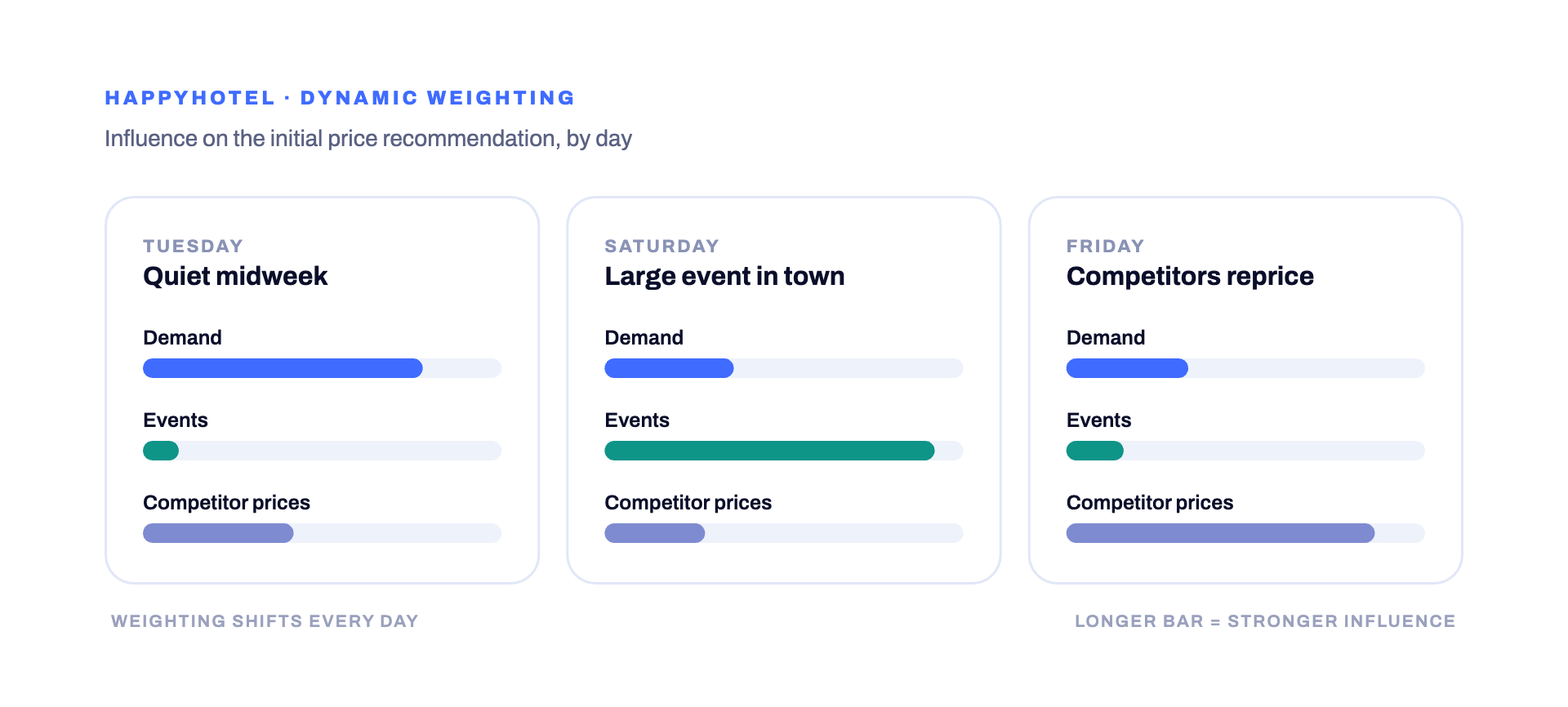
Demand, Events and Competitor Prices Are Weighted Dynamically
The three factors behind the initial price recommendation do not have the same influence every day. Their weighting changes dynamically according to the situation, rather than following one permanently fixed formula.
In practice, this means demand, events and competitor prices can contribute differently from one day to another. Pricing Transparency makes those changing influences visible so you can better understand what contributed to the recommendation.
What Happens After the Initial Price Recommendation?
The initial recommendation is not necessarily the final price. Additional information and your own pricing settings can also influence the result.
This is where booking speed, minimum and maximum prices, and pricing strategies come into the process. Pricing Transparency makes those additional influences visible so that you can distinguish between the initial recommendation and the final price shown in happyhotel.
Booking Speed
happyhotel also takes into account how booking behaviour is currently developing at your hotel. This booking speed is displayed as part of the explanation behind the recommendation.
It provides additional context about the current booking situation and helps explain why the final price may differ from the initial recommendation.
Minimum and Maximum Prices
Your own pricing limits can also affect the final result. If a minimum or maximum price applies, Pricing Transparency shows that the limit has intervened.
This makes it possible to distinguish between the initial recommendation, a pricing boundary you have defined and the resulting final recommendation. If the final price differs from the initial recommendation because of one of your own limits, you can see why.
Pricing Strategies
Defined pricing strategies can also affect the final price. If a pricing strategy applies to a particular day or room category, happyhotel shows that it has intervened.
This gives you visibility into the role your own settings played in the final recommendation and makes it easier to understand why the final rate may differ from the initial price.
From Initial Recommendation to Final Price
The easiest way to understand the pricing logic is to look at the different stages of the recommendation together.
| What you can see | What it tells you |
|---|---|
| Initial price recommendation | The dynamic starting recommendation |
| happyhotel demand indicator | Where the current forecast for your hotel stands |
| Events | Whether and to what extent an event influences the price |
| Competitor prices | Where your competitors currently stand |
| Previous recommendation | How the recommended price has changed |
| Booking speed | How current booking behaviour is developing |
| Minimum / maximum prices | Whether one of your price boundaries affected the result |
| Pricing strategies | Whether a defined strategy intervened |
| Final price recommendation | The resulting recommendation after the relevant influences and settings |
Together, these elements answer a very practical question: Why is happyhotel recommending this price today?
Instead of seeing only the final number, you can follow the path that led to it and understand which signals and settings contributed along the way.

Example: Why Might a Hotel Price Recommendation Change?
Suppose you look at a future stay date and notice that happyhotel's recommended price has changed since the previous suggestion. Rather than seeing only the new number, you can inspect the information behind the change.
You might see that the demand indicator has changed, an event is influencing the date, competitor prices have moved, booking speed is developing differently, or one of your minimum prices, maximum prices or pricing strategies has affected the result.
The important point is not that one factor must always be responsible on its own. Pricing Transparency helps you understand which information and settings contributed to the recommendation, so the change can be viewed in context.
Why Does Pricing Transparency Matter?
Automated pricing can save time, but it is also useful to understand why a particular recommendation has been made. A common question when working with automated hotel price recommendations is: Why is the system recommending exactly this price today?
Pricing Transparency is designed to answer that question by showing whether the recommendation reflects the current demand forecast, an event, competitor pricing, current booking behaviour, your own price limits or a defined pricing strategy.
This does not mean that every pricing decision needs to be analysed manually. The value is that when you do want to understand a recommendation, the relevant information is visible rather than hidden behind the final number.
Pricing Transparency Does Not Mean a Fixed Pricing Formula
Making the pricing process visible does not mean reducing it to a fixed set of rules. Demand, events and competitor prices are dynamically weighted every day, while the demand indicator continues to adapt as new data becomes available.
Booking speed and your own pricing settings can then influence the final result. As a result, the explanation behind a recommendation can change as the situation changes.
That is why looking at only one factor would not provide the full picture of how a happyhotel recommendation was created. For a broader explanation of dynamic pricing itself, see dynamic pricing at happyhotel.
What Can You See for Each Day and Room Category?
For every day and every room category, Pricing Transparency gives you visibility into the factors behind the recommendation and the path to the final price.
You can see the initial recommendation, the demand indicator, whether events influence the price, where competitors currently stand, how the recommendation changed, how booking behaviour is developing, whether your minimum or maximum prices affected the result, whether a pricing strategy intervened and what the final recommended price is.
In other words, you can see both what price happyhotel recommends and how that recommendation was reached.
See Pricing Transparency in Practice
We also presented Pricing Transparency in a webinar and showed how the pricing explanation works using specific examples. The current webinar recording is in German, so this article is designed to remain fully understandable without it.
Want to See How happyhotel Creates Hotel Price Recommendations?
If you want to see how our hotel price recommendations and Pricing Transparency work inside happyhotel, book a demo with our team. You can also compare our plans or see our available integrations.
Frequently Asked Questions About Hotel Price Recommendations in happyhotel
How does happyhotel create hotel price recommendations?
happyhotel first calculates a dynamic initial price for each day based on three key factors: the happyhotel demand indicator, events in the area and competitor prices. These factors are dynamically weighted. Booking speed and your own pricing settings can then also influence the final recommendation.
What factors influence the initial happyhotel price recommendation?
The three main factors behind the initial recommendation are the happyhotel demand indicator, events and competitor prices.
Does happyhotel give each pricing factor the same weighting?
No. Demand, events and competitor prices are dynamically weighted every day, so their relative influence can change depending on the situation.
How does happyhotel use events in hotel price recommendations?
For automatically imported events, the relevant number of visitors is taken into account directly in the demand indicator. Manually maintained events can be weighted by the user, including new or unique events that cannot be represented historically.
Does happyhotel use competitor prices?
Yes. Competitor prices are one of the three key factors behind the initial recommendation. happyhotel also shows where competitors currently stand and how the recommended price changed compared with the previous suggestion.
Does booking speed affect the recommendation?
Booking speed is additional information taken into account and displayed as part of the pricing logic.
Can my minimum and maximum prices affect the final recommendation?
Yes. If minimum or maximum prices apply, they can affect the final result, and Pricing Transparency shows when those limits have intervened.
Can pricing strategies affect the final price?
Yes. If a defined pricing strategy applies to a day or room category, it can affect the final result and is shown as part of the pricing explanation.
What is Pricing Transparency in happyhotel?
Pricing Transparency is the feature that shows the factors and settings behind a happyhotel price recommendation, including the initial recommendation, demand indicator, events, competitor prices, booking speed, pricing limits, pricing strategies and final recommendation.


